Acceity

Site Navigation:

Topics:


Archived posts from September, 2008:

Music Everywhere

19 September 2008 | Category: Arts

I am wearing headphones. Music is playing in my ears. The track is "Far East Sweet" by The Bruces, but that isn't important. After all, there are a few thousand tracks on my mp3 player. Whenever I'm in the mood for some music, I can just scroll through the choices. It doesn't matter who I want to listen to: Bob Wills, Queen, Devotchka, the Packway Handle Band—wherever I go, they're all ready and waiting in my coat pocket.

My situation is hardly unusual. It seems there is a wealth of music waiting at everyone's fingertips today. This isn't just because of mp3 players. There are also televisions, computers, car stereos, cell phones, and the ubiquitous speakers in malls, restaurants, and department stores. Music is so common now as to be nearly inescapable. From the moment we wake up to the melody of an alarm clock until the moment we turn off the TV or stereo before bed, we find ourselves working, studying, playing, driving, dining, shopping, and even exercising to a soundtrack that almost never completely fades.

This hyper-abundance of music is a remarkably new phenomenon. Most of the music formats people are familiar with today didn't exist a few decades ago. The ability to record and replay music itself wasn't realized until 1877, when Thomas Edison invented the first practical phonograph. Before this invention, it was impossible to duplicate a musical performance. Every musical rendition was unique, and the availability of a particular performance was limited to those people who inhabited the same time and place as the performers.

The advent of recording technology changed this by enabling people to duplicate individual performances as often as they wanted, so long as they had a copy of a recording and the equipment needed to play it. In other words, musical performances were no longer limited to a unique time and place, but were instead limited to technological availability. As technology has improved over the last century, both sound recordings and the devices that play them have become inexpensive and highly portable. This has allowed sound recording technology to proliferate widely, ensuring that recorded music music is are now available to virtually everyone, anywhere and anytime.

Our age of unprecedented musical abundance has led to many changes in the way people use, appreciate, and value music.
Read the rest of this entry »

Posted By: Joshua | 2 Comments »

Walking Among A Crowd

9 September 2008 | Category: Miscellany

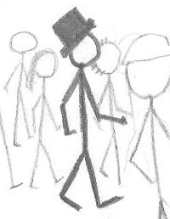
A Crowd of Walking Stick Figures

I'm walking, slowly, on a campus sidewalk. Around me, others are walking too. They are walking faster than I am, not swiftly, but steadily passing me as they go hither and thither about their days. There are many of them, and most of them are moving together, as one. They flow down the sidewalk together as if a liquid, occasionally damming up behind an obstacle before finally funneling through doors and filtering into their countless destinations. I am only a stone in their river, and as they wash past me on all sides, I too am prodded slowly forward along their course.

I begin to walk faster, until I, too, am one with the liquid mass. It is a new world. At my own pace I had been but one among many, but now we all walk together, a thousand chattering friends in the great hall under the sky. Our conversations come with us as we go; we share tales of the day thus far and make plans for the night to come. We smile and joke and laugh, and we become oblivious to all of our surroundings. It is almost as if we, the walking, were still, and the world was moving briskly beneath our feet.

Read the rest of this entry »

Posted By: Joshua | 4 Comments »

Thinking About You

4 September 2008 | Category: Language

I've been thinking about you. No, not you personally. I mean that I've been thinking about you, the actual word. I can already tell that this might get confusing. You is such a common word that it's difficult to pull back from its everyday usage and discuss it deeply and objectively. However, the very fact that you is used so frequently means that it can offer tremendous insight to those who are willing to discuss it. You has passed over the lips of so many people in so many contexts over so great a time that it touches on nearly every aspect of history, society, and language in the English speaking world. What follows is only a brief introduction to a word that can speak volumes.

You is a pronoun. More specifically, you is a second-person personal pronoun, and it's the only second-person personal pronoun that contemporary English speakers use with frequency. No other word is really necessary for the job; you is incredibly one-size-fits-all. It is singular and plural, nominative and objective, formal and familiar. The subject of an address, when not called by name, is nearly always called you. I'm writing for you, now, and I am able to call you you no matter who you are, simply because it is you that I am addressing. That's the rule.

Many other languages offer a little more variety. French, for example, has two words that translate into English as you. The first of these, tu, can only be used to address one person on a familiar level. The other word, vous, must be used instead of tu when addressing groups of two or more people. Vous can also be used to address one person in a way that conveys additional respect. The English word you offers no such distinctions.

There is also no difference in English between you when it used as the subject of a verb, and you when it is used as the object of a verb (or the object of a preposition). This is quite unlike the situation for the first- and third-person pronouns in English. I, we, he, and she can only be used as subjects. Me, us, him, and her can only be used as objects. You is an exception; it works in either setting.

You was not always used in so many different contexts. Read the rest of this entry »

Posted By: Joshua | 1 Comment »

Powered by WordPress 3.0.1  |  Valid XHTML 1.0 / CSS  |  Privacy Policy  | Copyright © 2008-2010 Joshua Wachuta