Acceity

Site Navigation:

Topics:


Archived posts from July, 2009:

Little Things

28 July 2009 | Category: Nature

I don't usually have an issue with not being able to see the forest for the trees. This afternoon, though, even trees seemed hard to find—I was far too preoccupied with the branches. As I walked into the valley, little things, little ordinary things, kept stealing my attention. Here are a few big pictures of the little things I encountered.

I. Young Pears Still Growing on the Tree

It'll be a fruitful harvest, in every sense of the word. And what could be better to accompany my favorite artisan cheeses?
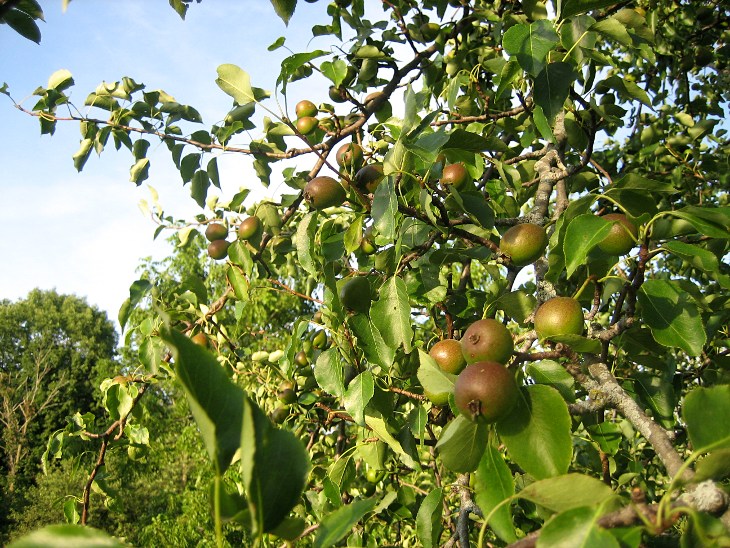
Small egg-shaped pears hang abundantly alongside the green leaves of a pear tree.

II. Green Acorns at the Foot of an Oak Tree

I wonder if they fell here during one of the storms we had this week?

A pair of unripe acorns are still connected to a twig lying against the rough bark of an oak tree.

III. Yellow Mushrooms in the Moss

I think these are Cantharellus minor—meaning they're edible—but I don't trust my mushroom-identifying skills well enough to taste.

Three tiny toadstool-shaped mushrooms rise out of the leafy moss. Two are bright yellow, the other is shriveled and turning brown.

Zooming in on the small stuff was a refreshing change from the panoramas that surround me at my home atop the ridge, and when I did make my way back up the hill, I realized that upon drawing back from these close-ups, the big view seems even larger. Every grand vista from the top of my hill is made up of a million little scenes like these.

Posted By: Joshua | 1 Comment »

The Local Web

25 July 2009 | Category: Internet

One of the greatest things about the Internet, in addition to its convenience, speed, and interactivity, is its open nature. Wheras the "little guy" is often barred from traditional media like printing and broadcasting because of the high costs and deeply-entrenched competition, the Internet offers an inexpensive way for all kinds of people to easily publish their ideas around the globe. While this lack of barriers has allowed for a lot of amateur and low-quality material on the web, it has also provided for the creation of many first-rate publications, some of which might never have existed otherwise. Some of the neatest sites have come from small towns and local neighborhoods where residents have made use of the Internet to strengthen their communities and offer immediate perspectives that can't be rivaled by the bigger, corporate media. Lately I've been finding a lot of websites dedicated to the news, culture, and history of small towns in the region around my home in southwest Wisconsin. I thought I'd share three of my favorites here today:

  • The Kickapoo Free Press is an independent monthly magazine from Viroqua, Wisconsin, with a print and online edition. It features in-depth news and thoughtful opinions from the Kickapoo Valley region, and I love its emphasis on cultural and humanistic reporting. The writers for the Kickapoo Free Press do a marvelous job of depicting rural and small-town life in western Wisconsin, and the issues they discuss make this magazine a must-read for anyone with a stake in the region.
  • PDC Today is a relatively new website dedicated to covering the latest news from Prairie du Chien, Wisconsin, and its neighboring communities. The website features daily updates, along with streaming audio and video of recent news stories in the area. There are also Twitter updates for breaking news and a "Life" section about area events and culture. Overall, PDC Today makes for a great way to stay up to date on what's happening in that part of the state.
  • Focus on PDC is another blog from Prairie du Chien, but this one puts more emphasis on yesterday—it's author has been hard at work digging up information on some of the city's lesser known historic sites. Prairie du Chien is well known for its long and eventful history, but some stories tend to crowd out the others. The Focus on PDC blog brings many of these forgotten curiosities into the spotlight with new research on historic people and places.

Be sure to check out these sites if you're a fellow Western-Wisconsinite, and as always, check the Links Page for a complete list of my favorite websites. Also, if you know of any other sites dedicated to the news and culture of small towns in Southwest Wisconsin, leave a comment and let me know.

Posted By: Joshua | 1 Comment »

The Genetics of Language

21 July 2009 | Category: Language

Genetics is the study of inherited variation. While it usually refers to biological heredity, genetics can apply to language as well. Language, like life, is constantly evolving. From the time when an utterance is first given meaning, it is subjected to powerful forces of change. Some words are never more than passing fads, and they die within a generation. Other words take a strong hold. Over time, these survivors mutate and their families expand. The largest word families can fill pages of dictionaries in several languages. What better word-family to exemplify the genetics of words than the family that includes the word genetics itself?

The English noun genetics, first used in its current sense in 1905, is immediately descended from the adjective genetic, meaning "of or relating to origin or development." Genetic, in turn, is derived from the Latin word genesis, borrowed from the Greek word γένεσις (genesis), which means origin or creation—you may recognize it as the name of the first book of Judeo-Christian scripture. Finally, the word genesis itself stems from the Proto-Indo-European root gen-, meaning "to produce" or "to be born."

The Proto-Indo-European language (PIE) was spoken around five or six thousand years ago. Its use predates the development of writing, which means that this language left no direct record of its existence. The exact time and place when it was spoken is hard to trace with certainty. Nonetheless, linguists are certain that PIE existed, because it left children: other languages that were written and that are so similar they must have sprung from a common ancestor. These related languages, which originated as regional dialects of PIE and slowly drifted apart into separate tongues, form a group called the Indo-European language family. This family today includes over 400 languages, including English and its close relatives like German and French, as well as more distant cousins like Greek, Russian, Persian, and Hindi. All these languages have a common origin, which means they are endowed with many similarities. Look, for example, at the word used to mean "mother" in various Indo-European languages:

English German French Greek Russian Persian Hindi
Mother Mutter Mère μητέρα (mētéra) мать (mat') مادر (madar) माता (mataji)

These words are too similar to have come about independently—they share a common root. By comparing the word for mother in various Indo-European languages, linguists can reconstruct a hypothetical root word in the Proto-Indo-European language. In this case, the root word is believed to be mater. This root word has also mutated in other directions, so a number of modern English words can be counted as its children, including maternal, matron, matriarch, matrix, and matriculate.

Read the rest of this entry »

Posted By: Joshua | 2 Comments »

At Long Last: A New Post

17 July 2009 | Category: Site News

It's been far too long since my last update—but I've been busy. Since my last post, I've finished semester finals, started a summer internship, traveled to Virginia and back, and knocked a few more books off my ever-growing reading list. Unfortunately, blogging slipped by the colloquial wayside. Now I have a little more time to put into Acceity, though, so updates will be more frequent for the remainder of the summer.

There have been a few changes here since my last post. First, behind the scenes, I've switched servers, from Bluehost to Inmotion Hosting. In doing so, I've both saved myself a little money and gotten a higher-capacity hosting account. The move has been pretty smooth, but I can never be sure if I've transfered every little thing properly from one host to the other, so it's possible there are a few glitches remaining to be smoothed out here in the next couple days. If you find one, let me know.

More visibly, you'll also notice that I've given Acceity an entirely new look. The updated design has its pros and cons, but I was aiming for something simpler, brighter, bolder, and altogether more suited to immersive reading. After all, this is a website where you can still find good, hearty servings of prose—an increasing rarity among the flashes and bangs of the multimedia-enhanced but attention-deficit web—and I think Acceity is now optimized to make reading long passages of text here almost as comfortable as reading long passages of text out of a magazine. We're talking serifs, bigger fonts, more whitespace, fewer distractions. You can just sit back, relax, and read.

This time next week, there will actually be something here to read.

Posted By: Joshua | 4 Comments »

Powered by WordPress 3.0.1  |  Valid XHTML 1.0 / CSS  |  Privacy Policy  | Copyright © 2008-2010 Joshua Wachuta