Why I’m Not on Facebook: Revisited
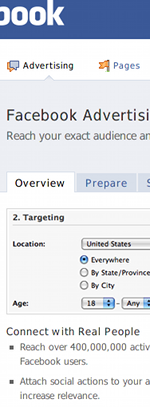
“Our business is advertising.”
These are the words of Facebook Chief Operating Officer Sheryl Sandberg, from an interview published in the April 20, 2009 issue of BusinessWeek. She continued:
“We believe advertising needs to blend into the experience … we don’t have big banners across the site, nor do we have text-based ads that are really part of the search experience. We have ads that act like our site.”
Facebook is the world’s premier social networking website. Hundreds of millions of people use it to keep in touch with their friends, families, and associates. These are the relationships and conversations that make human life meaningful. But:
“These naturally occurring social actions now also can be paired with sponsored content and advertising to create a Social Ad.”
– Facebook Product Overview FAQ
Facebook is a privately owned company that profits by surreptitiously injecting paid advertisements into its users’ human relationships.
“You understand that we may not identify paid communications as such.”
– Facebook Statement of Rights and Responsibilities. (“By using or accessing Facebook, you agree to this Statement.”)
Research firm eMarketer predicts that advertisers will spend $605 million to reach Facebook users in 2010 — a 39% increase from 2009. Marketers are increasingly confident that the money they spend at Facebook will draw consumers to pay for their products and services.
“People treat Facebook as an authentic part of their lives, so you can be sure you are connecting with real people with real interest in your products.”
– Facebook case study in a promotional message to advertisers.
People from around the globe login to Facebook hoping to share stories of life, love, hope, and achievement. Facebook’s aim is to make them talk about commercial products instead.
“The next hundred years will be different for advertising, and it starts today. … We are announcing a new advertising system, not about broadcasting messages, about getting into the conversations between people.”
– Facebook CEO Mark Zuckerberg, at a press conference on November 6, 2007. Quoted by TechCrunch.
“[Facebook has] put the power of recommendation and referrals into a systematic environment.”
– Chamath Palihapitiya, Facebook VP-product marketing and operations. Quoted in the November 12, 2007 issue of Advertising Age.
Facebook’s entire financial model rests on the fact that its users — or more accurately its used — are willing to display products as prominently as their friends and build their identities out of advertisements. John Doe’s Facebook profile does not list his beliefs, his achievements, or his goals. It is not set up to demonstrate his individuality or creativity or personality. It simply lists, “John Doe is a fan of: [insert brands here].” This is exactly how Facebook wants it to be.
“Facebook Pages are designed for businesses and brands to efficiently interact and communicate with users. Through Pages, businesses can engage with their fans and capture new audiences virally through their fans’ recommendations to their friends.”
– Facebook Product Overview FAQ.
It doesn’t stop here. Third party companies that develop Facebook applications also sell their users to advertisers.
“Slide offers brands a direct conduit to the most valuable audience on the web: young, engaged users who are eager to click and eager to share … Slide placements perform better than traditional online placements because the ads are not merely near the entertainment, they are the entertainment.”
– Slide promotional message to advertisers.
Slide, Inc. develops popular Facebook applications including SuperPoke!, which boasts approximately 150 million users. Its promotion continues:
“By weaving advertisements into the sponsored actions, brands receive maximum engagement. SuperPoke! is the definitive and most recognizable application on Facebook, and metrics prove that it is a highly effective advertising buy.”
These applications encourage Facebook users to structure their daily social interaction around branded products (e.g. spray a friend with branded perfume). Facebook makes it easy for application developers to deliver targeted advertising to their users:
“When you add an application and use [the] Platform, your content and information is shared with the application.”
– Facebook Statement of Rights and Responsibilities.
Meanwhile, market research companies such as the Acxiom Corporation offer to help businesses develop targeting advertising campaigns using social networking sites.
“Acxiom Relevance-X® Social helps you see the social networks of your customers and how many friends or contacts they may have within online communities. … With Acxiom Relevance-X Social data, marketers can establish and maintain up-to-date social intelligence on their customers, interact with socially active brand advocates … and influence the influencers in a respectful and engaging way to drive purchase behavior.”
– Acxiom Corporation promotional message for direct social media marketing.
Facebook’s advertising creates a culture of consumerism. Users of the network define themselves by things rather than actions. Without thinking, they announce that they are “fans” rather than striving to be leaders. As a result, Facebook discourages inventiveness and destroys individuality. It promotes the opposite, and its users buy into mindless money-driven fads, surrendering their personality to become a particle in the mass of millions. The entire site is structured to make users build their relationships and identities around commercial products, turning human emotion, affection, and trust into commodities packaged and sold to advertisers.
The only way out of this hyper-commercial environment is to leave Facebook — but often that means losing the best way to keep in touch with friends, family and loved ones. Facebook makes it hard to leave. It has assembled the perfect captive audience for marketers. Don’t be trapped. Imagine life off Facebook, without advertising, on your terms. Imagine the potential of relationships built around meaning rather than marketing, and commitments rather than clicks. I will not be held hostage. Will you?
No Responses to "Why I’m Not on Facebook: Revisited":
This is only written after one read, but my main point is: Yes, Facebook is full of advertisements, and if you want to, you can turn your Facebook page into a display of what brands you prefer. But I don’t. I’m only “fans” of musicians and bands. I use Facebook for its messaging system, for its quick and easy organization (creating events, inviting people), to keep in touch with friends, and for an easy way to upload and view photos. None of that has to do with this intense, hyper-commercial environment that you are discussing, it exists with or without it. Sure, the environment is still there, but being in America, we’re kind of used to living in a consumerist culture. It’s a matter of choice, you can engage with it and become part of it, or you can choose not to, like I and many people do. Then you see Facebook for its useful tools, you use Facebook rather than letting it use you.
The only real choice is between using Facebook and not using it. Yes, you can jump through hoops to try and ignore or circumvent Facebook’s advertising, but as you admit, “the environment is still there.” Facebook is structured around marketing whether you engage with that marketing or just sit by passively as it appears on your screen. Your choice is between putting up with that, or daring to be different enough to take your relationships outside Facebook where you can structure them in an infinite number of more personal and meaningful ways.
The internet provides countless alternatives for sending messages, keeping in touch, and sharing photos. I do all of those things, but I do them on my terms, as an individual, instead of prostituting myself at Facebook for the sake of these simple tools.
Being used to a consumerist culture is no excuse for accepting it. In fact, that should be an urgent warning sign. Advertising works by familiarity, by making you used to something. You might not pay any attention to it when it appears, but when you go to the store, will you buy the product with the name you recognize, or the one you’ve never heard of? Does the fact that a company paid money to publicize the familiar product make that product better?
If you view Facebook’s commercialized culture as normal, then you will not understand how destructive it is until you are able to see or imagine the alternative: a life structured around purpose rather than products — a life that is vanishing. Being a fan of a musician is little different than becoming the fan of any other product. The global music industry is worth $40 billion. You’re still defining yourself by what you are a fan of, rather than by who you are, what you have done, and what you hope to do. Facebook makes no provision for those concepts. Facebook is a community of 400 million people who are relentlessly taught to define themselves by other people’s products, ideas, and money, while forgetting whatever might have come from inside themselves — and for what? Keeping in touch? Sharing photos? That’s nothing but a minor enhancement of email.
Yeah, but Facebook is fun.
Also, I do have meaningful relationships outside of Facebook as well. Just because I have a Facebook doesn’t mean I use it as my only way of communicating with people.
And, almost every event in life has a bit of advertising. When I go home for Thanksgiving I’m aware of the products my grandmother uses to make dinner (Butterball, Ocean Spray, Green Giant, Lindmann’s, etc.) I’m not saying that my grandmother is promoting those brands; however it definitely influences me in the items I choose to buy. Yes, if I’m buying canned veggies, I will get Green Giant, and I would probably buy a Butterball turkey when I host my first Thanksgiving.
How about when you’re spending time with friends? I know when I get together with my girlfriends we talk about the products we use, the hair stylists we go to, and the movies we see. In a way, that’s kind of like advertising.
What about events? When I go to a play or another school event, we usually use a portion of the time to plug another event. Isn’t that like advertising too?
Advertising is everywhere – even in our personal relationships. So what if it’s on Facebook? I usually pay more attention to my messages than the advertisements anyway.
As I said above, being used to a consumerist culture is no excuse for accepting it. I recommend reading Aldous Huxley’s novel Brave New World. It’s world was also “fun,” but it shows how superficial that fun is compared to the trajectory of modern consumerism. It’s also just a good read — Modern Library ranked it as the 5th best novel of the 20th century, right below Lolita.
What I’m seeing from the comments so far is that people are so used to advertising as a part of their lives that they can’t even conceive of a world that might be different, and they blindly dismiss any challenge to the system that produced them. Your example of Thanksgiving dinner, however, is a perfect illustration of what I am trying to say. You can center your idea of a good Thanksgiving meal around the brands your family uses to cook with — brands used by millions of people, brands which do nothing to distinguish your dinner from a million Thanksgivings elsewhere — or you can can center your concept of a good Thanksgiving meal around your family’s recipes and serving traditions: the one-in-a-million things that make your Thanksgiving a unique, special, personal experience.
Facebook and other marketers have trained you to anchor your identity and your relationships around brands, brands which homogenize us and steal attention away from the intangible qualities of life that really can make our experiences fun, memorable, and unique. Compare life today to life just 150, 100, or even 50 ago, and you will see that although people are a tad more prosperous now (or maybe a tad less, in the 50 year category), they have lost their diversity, they have given up their sense of place and sense of identity, and most tragically, they have given up the ability to dream and their courage to try and change the world around them.
Advertising in 2010 is everywhere, yes — so you can just give up and say it’s inevitable, or you can take a stand against it. The first step is as easy as quitting Facebook. Your choice is between letting yourself be defined by the world of advertising around you, or building yourself from within to become a person who helps shape the world.
Propaganda, as I see it, cannot be ignored, for to be ignored is a conscience effort to notice it.
Great point. Ignoring something means accepting it as a part of your world and not thinking about it — exactly the wrong move, because that makes an opening for propaganda to feed directly and uncritically into your subconscious and define what you consider normal. The only way to successfully confront propaganda is to shut it out altogether (i.e., turn off the TV, or quit visiting advertising-dense social networking sites), or else to think critically and constantly about it in order to unravel its flaws and contradictions and maintain the integrity of your independent perspective.