Note: This article documents flooding that occurred in April 2011. As of May, Prairie du Chien is once more dry and green, and all the parks and historic sites mentioned below are now open for visitors.
The Father of the Waters is reenacting a familiar natural drama at Prairie du Chien, Wisconsin. Swollen by spring rain and melted Minnesota snow, the Mississippi River will carry over 1.5 million gallons of water past town each second during the peak of the Flood of 2011. While the power of the river is awe inspiring, the latest flood is nothing new. At Prairie du Chien, the Mississippi is immersed in history.
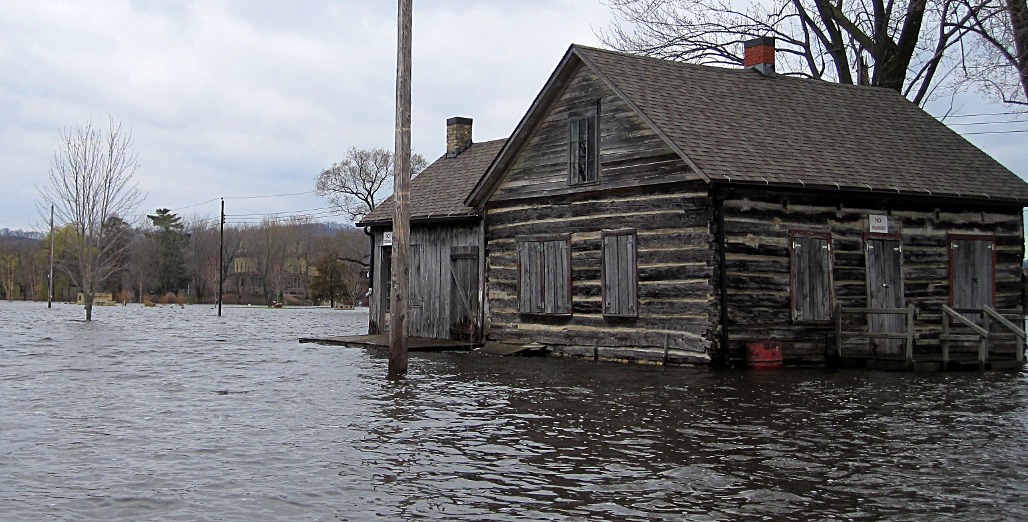
Floodwater began to seep around the foundations of Fort Crawford on Monday, April 11, 2011. The two-story blockhouse is a replica constructed in the 1930s. The fence surrounds an excavated stone “prison pit” from the fort that has filled with water.
On April 11, 2011, floodwater began to creep across the foundations of Fort Crawford, one of Prairie du Chien’s most significant archaeological sites. Built in 1816, Fort Crawford was a federal military installation intended to secure control of the Upper Mississippi River for the United States. It was also situated on an island in the middle of a floodplain.
One year after Fort Crawford had been built, Major Stephen H. Long made an inspection of the post. “In regard to the eligibility of the site upon which Fort Crawford is erected,” wrote Long, “very little can be said in favor but much against it. … The site has been repeatedly subject to inundation, which is always to be apprehended when excessive floods prevail in the river.”
Major Long’s apprehensions proved well-founded. In 1823 he returned to Fort Crawford along with William Keating, who noted:
The river bank is here so low and flat, that by a swell which took place in the Mississippi the summer before we visited it, the water rose upon the prairie, and entered the parade, which it covered to the depth of three or four feet; it penetrated into all the officers’ and soldiers’ quarters, so as to render it necessary for the garrison to remove from the fort and encamp upon the neighboring heights, where they spent about a month. The waters having subsided, at the end of that time, they returned to their quarters; the old men about the village say that such an inundation may be expected every seven years.
The United States Census Bureau today released its first official 2010 population figures for Wisconsin counties, cities, villages, and towns. These are exciting numbers, and not only for comparing rival cities and hometown trends. The census data will be used, among other things, to tweak the boundaries of congressional and state legislative districts to ensure equal representation — a process that will no doubt be mired down in gerrymandering and political intrigue. I’ll set that aside for this post, however, and focus on the numbers.
Wisconsin’s population grew from 5.36 million to 5.68 million between 2000 and 2010. That’s an increase of about 6% — slower growth than in most states, so Wisconsin’s rank has slipped from 18 to 20 over the last ten years. That slide in proportion is small enough that Wisconsin will still keep eight congressional representatives and ten electoral votes for the next decade. While overall growth was sluggish, it’s notable that the state’s Hispanic population increased by over 72% in the last ten years. Hispanic residents now make up nearly 6% of the state’s total population.
The map below shows the relative change in the total population of Wisconsin’s counties:
The map shows that Wisconsin’s population growth was spread fairly consistently across the state and carried over into many rural counties, with the exception of the north woods. Fifty-two counties gained population, and twenty had a loss. This is a stark contrast to what happened in Iowa, where 2/3 of the counties saw a population decrease.
Wisconsin’s largest cities remained fairly steady over the last ten years. Milwaukee continued to lose population but at a decreasing rate, and it remains by far the state’s largest city. Near Milwaukee, Racine and West Allis also lost population, while Waukesha grew by 9%. Madison saw its population rise by 25,155 people, a jump of 12%. The only change in ranking was that Janesville overtook West Allis as the state’s 10th largest city.
Wisconsin’s 10 Largest Cities in 2010 and 2000
City
2010
2010 Rank
2000
2000 Rank
Pop. Change
% Change
Milwaukee
594,833
1
596,947
1
-2,114
-0.35%
Madison
233,209
2
208,054
2
25,155
12.09%
Green Bay
104,057
3
102,313
3
1,744
1.70%
Kenosha
99,218
4
90,352
4
8,866
9.81%
Racine
78,860
5
81,855
5
-2,995
-3.66%
Appleton
72,623
6
70,087
6
2,536
3.62%
Waukesha
70,718
7
64,825
7
5,893
9.09%
Oshkosh
66,083
8
62,916
8
3,167
5.03%
Eau Claire
65,883
9
61,704
9
4,179
6.77%
Janesville
63,575
10
59,498
11
4,077
6.85%
West Allis
60,411
11
61,254
10
-843
-1.38%
Here in Southwest Wisconsin, every county except Crawford gained population. A number of factors likely contributed to Crawford County’s loss, but the major back-to-back floods on the Kickapoo River in 2007 and 2008 no doubt played a role: Gays Mills in Crawford County lost over a fifth of its residents; Soldiers Grove lost nearly one in ten. The county seat at Prairie du Chien also experienced a slight decline.
In Grant County, Cassville fell below 1,000 people, and the county seat Lancaster experienced a slight decline, but Platteville’s population jumped from 9,989 to 11,224. Fennimore’s population skipped ahead of both Mineral Point and Darlington.
La Crosse, the largest city in the region, remains almost unchanged in size with only a slight decline, but it’s largest suburb Onalaska grew by nearly 20%.
The table below includes figures for several cities and villages in Southwest Wisconsin. Click on a column header to sort the table by that column.
Cities and Villages in Southwest Wisconsin
City or Village
2010 Population
2000 Population
Change
% Change
Black River Falls
3,622
3,618
4
0.11%
Boscobel
3,231
3,047
184
6.04%
Cashton
1,102
1,005
97
9.65%
Cassville
947
1,085
-138
-12.72%
Darlington
2,451
2,418
33
1.36%
Dodgeville
4,693
4,220
473
11.21%
Fennimore
2,497
2,387
110
4.61%
Gays Mills
491
625
-134
-21.44%
La Crosse
51,320
51,818
-498
-0.96%
Lancaster
3,868
4,070
-202
-4.96%
Mineral Point
2,487
2,617
-130
-4.97%
Onalaska
17,736
14,839
2,897
19.52%
Platteville
11,224
9,989
1,235
12.36%
Prairie du Chien
5,911
6,018
-107
-1.78%
Reedsville
1,206
1,187
19
1.60%
Richland Center
5,184
5,114
70
1.37%
Soldiers Grove
592
653
-61
-9.34%
Sparta
9,522
8,648
874
10.11%
Spring Green
1,628
1,444
184
12.74%
Tomah
9,093
8,419
674
8.01%
Trempealeau
1,529
1,319
210
15.92%
Viroqua
4,362
4,335
27
0.62%
Westby
2,200
2,045
155
7.58%
You can dig for even more census data at the Census Bureau’s American Factfinder website. What do you make of the new figures? As always, feel welcome to comment below.
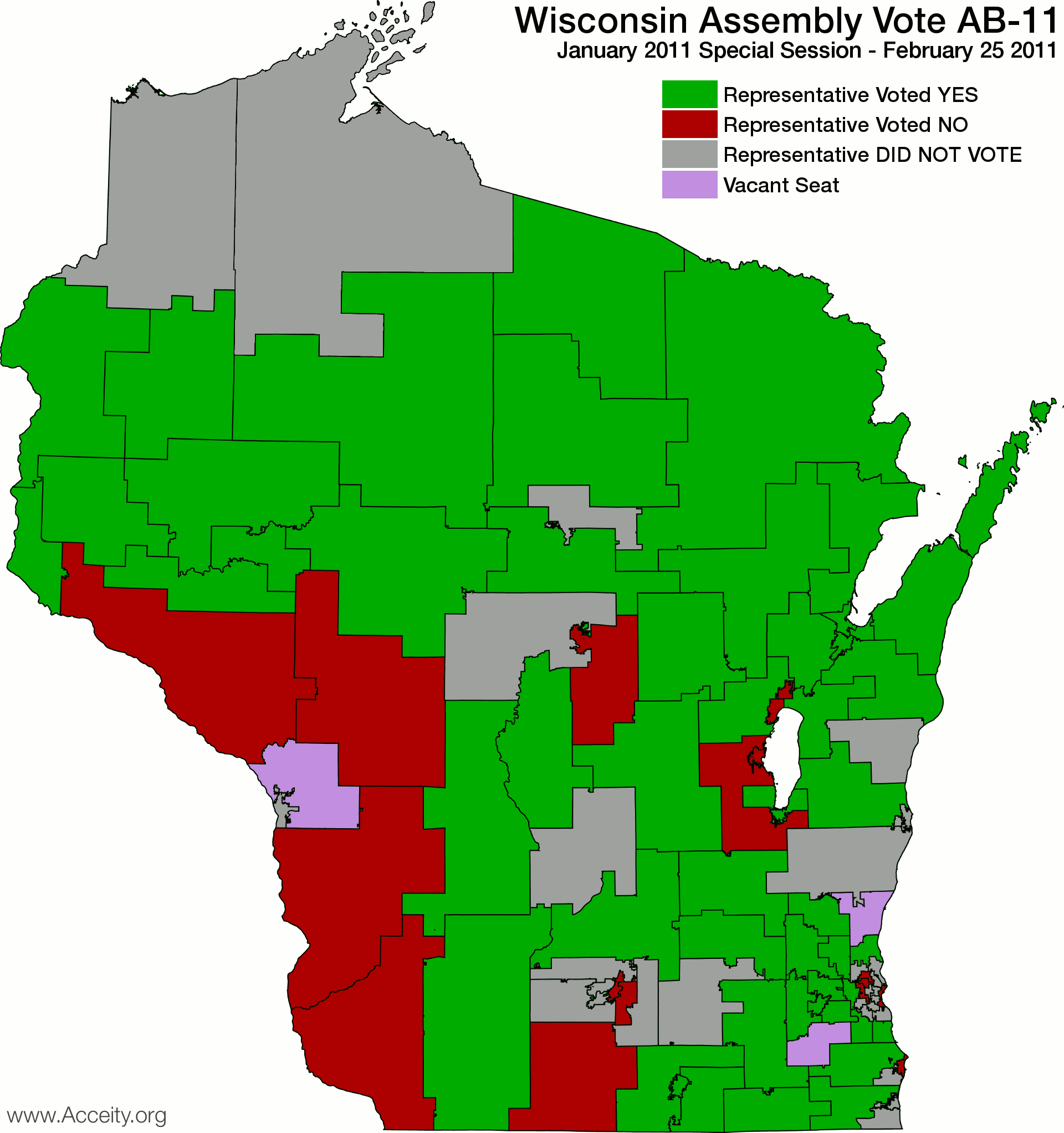
By now just about everyone has heard about the contentious Wisconsin Assembly vote early Friday morning that approved Governor Scott Walker’s contentious “budget repair” bill in mere seconds — without even allowing time for the entire assembly to vote! Since I couldn’t find a map of the vote anywhere else, I decided to make one myself. Now it is easy to see whose representatives have been listening, whose have not, and whose weren’t given a chance to represent their constituents at all.
You are welcome to copy and share this map. If you want more information, you can access the full vote roll from the Wisconsin State Legislature website. They also offer detailed and numbered maps of the state assembly districts.
Edit: The map has been corrected to show that Janet Bewley (D) of District 74 (Ashland) did not get in a vote. I apologize for any confusion caused earlier.
The protests this month in Madison have incorporated much discussion of fairness — something that people on all sides claim to be seeking. The debate reminds me of a quote by Dr. Samuel Johnson, a British scholar best known for compiling A Dictionary of the English Language in the 1750s. Dr. Johnson was a staunch conservative in an era when conservatism meant defending aristocratic privilege, and he once disparaged an egalitarian movement in England by remarking, “Sir, your levellers wish to level down as far as themselves; but they cannot bear levelling up to themselves.”
These words struck me as a very legitimate criticism. Why is it that those who stand up for fairness so often fixate on cutting down those who are better off, rather than lifting up all of society?
Make no mistake: Dr. Johnson was on the wrong side of political history. At the cusp of the American Revolution, for example, he wrote that “there can be no limited government” and that “since the Americans have made it necessary to subdue them, may they be subdued … When they are reduced to obedience, may that obedience be secured by stricter laws and stronger obligations!” This does not mean that all of Dr. Johnson’s observations lack merit. His comment about levellers seems enduringly and unfortunately relevant. It is, however, something we can change. When we work towards fairness, we should strive to level up, not to level down.
I grant that there are limits. We cannot all rise to be aristocrats, for there would then be no one left to serve our feasts or plow our fields. That dependence on servitude is where the truth becomes manifest: real unfairness comes not so much when some people have more than others, but rather when some people have more than others through coercion — when one class lives high by exploiting the labor of others.
People who legitimately seek fairness and equality will work, not to bring people down, but to raise people up by leveling the distribution of power, eliminating the privileges that give one class, race, or gender the power to exploit or to hold down the rest. That is the way to level up.
This post is long overdue. For years now, I’ve cringed at the constant appeals for “increased efficiency” made by managers, executives, politicians, researchers, journalists, teachers, engineers, activists, bosses, columnists, liberals, designers, coaches, conservatives, accountants, and radio talk show hosts. I think it is safe to say that we all agree: all of us want to make our businesses, our jobs, our governments, our schools, and our refrigerators more efficient. Efficiency is a good thing.
Efficiency, however, is a property of means, it is never an end, and it cannot be an ultimate goal. The thing that matters most is our choice of objects to efficiently accomplish. The business that efficiently returns value to shareholders is not necessarily the business that efficiently rewards good employees or that efficiently turns out efficient refrigerators. It is clear that machine guns and gas chambers are very efficient killing machines, but efficient murder isn’t a good thing at all.
When a merchant or a candidate or an employer tries to sell you on efficiency, it is a meaningless pitch unless you ascertain what sort of efficiency he or she means. Is the most efficient factory the one that makes widgets the most quickly, or the one that makes the strongest widgets? Is the most efficient government the one that does things for the least expense, or the one that does things for the most good? Is the most efficient plan for your boss the most efficient plan for you?
Let’s take a collective step back from this mad drive towards efficiency, and remind ourselves of our values, our goals, and what it is we’re trying so hard to accomplish. Using ends to justify means is bad enough. Don’t make the means into the end.
It’s official: 66 of 99 counties in Iowa lost people between 2000 and 2010, even while the overall state population increased by 4.1% owing to the growth of large cities and especially suburbs — continuing a decades-long trend. These details from Census 2010 were released today by the U.S. Census Bureau:
Iowa is the first state in the region for which detailed Census 2010 data has been released. The Census Bureau plans to release data on a rolling state-by-state basis to be completed by April 1. I’ll be sure to note the release of data for Wisconsin here at Acceity when that arrives. In the meantime, the Iowa returns offer something to think about.
Protests in Egypt continue to make headlines across the globe today, but not everyone is getting the same story. Take a look at this morning’s (8:00am CDT) top story from the web feeds of two leading news agencies on opposite sides of the Atlantic: the AP in the United States, and the BBC in the United Kingdom.
Gangs free militants, foreigners try to flee Egypt
“Gangs of armed men attacked at least four jails across Egypt before dawn Sunday, helping to free hundreds of Muslim militants and thousands of other inmates as police vanished from the streets of Cairo and other cities.” (article)
Protesters dominate central Cairo
“Anti-government protesters take over the centre of the Egyptian capital Cairo, as armed citizens’ groups form to counter widespread looting.” (article)
These stories naturally each go on at length, but I’ve only copied the headline and summary broadcast by each organization’s RSS/Atom feed. Often, this is all that subscribers glance at anyway.
Although both reports are rooted in fact, the difference in emphasis is startling. The AP headline, “Gangs free militants, foreigners try to flee Egypt,” stresses chaos, danger, and crime. The less sensational BBC headline, “Protesters dominate central Cairo,” stresses the scope of protest — a human right. You might say that the BBC emphasizes “civil” and the AP emphasizes “disobedience.”
The summaries show even more contrast. The AP raises the familiar American terror of “Muslim militants” freed by “gangs of armed men”, whereas the BBC recognizes “armed citizens’ groups.” These are not instances of using different terms to refer to the same thing; the focus is on different facts altogether. The facts are, however, related: the AP establishes that “police vanished from the streets,” stressing a descent into chaos, while the BBC confirms that “citizens’ groups form to counter widespread looting,” stressing the people’s positive attempts to maintain order.
What I’ve described is only one isolated example of the disparate perspectives that can arise between two supposedly neutral and objective news agencies. The Internet’s deleterious effects on our attention spans might exaggerate these differences, for when news writers compress complicated stories into one-sentence blurbs for syndication, they’re likely to concentrate their biases too. Thankfully, the Internet also provides readers with mechanisms for dealing with bias: we can subscribe to a dozen feeds like this from around the world and gain diverse perspectives on every issue, we can click “read more” for the full story, and we can discuss the news on blogs or social networks. The Internet gives us more tools for making sense of the world than ever before — and more reason to use the tools it gives us.
After the blizzard last night, when winds whipped the snow into great dunes on the ridge, it took a heavy duty end loader to finally dig out the road to the farm.
Mayor Dave Hemmer, who had earlier tried and failed to clear the road with a plow truck, now followed behind to clear up after the loader.
It’s toasty at home today where the turkey roasts, but yesterday’s freezing rain left a gloss of ice over the outdoor world. The blades of frozen grass in the front lawn look deadly sharp. You wouldn’t want to see the roads. Safe travels to everyone, and Happy Thanksgiving!
WASHINGTON, D.C. — A bipartisan group of 37 senators today announced support for the “Restoring Freedom in American Democracy Act,” introduced last week by senators Lewis Clark (R-Missouri) and Candy Cain (D-Nevada). If passed, the legislation would hand over responsibility for conducting federal elections to private companies. Supporters of the bill say it will help reduce government spending and ensure fairer, more efficient elections. Critics call the measure unconstitutional and fear it could disrupt voter rights.
“It’s time we end this socialist system of state-run elections and take government out of our God-given right to vote,” said Sen. Clark to cheers on Capitol Hill. “America needs to live up to its ideals of freedom and open its elections to the free market.”
The proposed bill would create a streamlined process for companies to secure authority to register voters, print ballots, operate polling places, and tabulate federal election results on a state-by-state basis. Officials hope competition between polling companies in each state will encourage greater efficiency on election day.
“We’ve all experienced long lines at the polls and late nights waiting for results on MSNBC,” explained Sen. Cain. “We can each remember the mess between Bush and Gore in Florida in 2000, or between Palin and Obama in 2012. The states just don’t do a very good job of running elections, and taxpayers will save money by allowing businesses to take over the polls.”
Wall Street welcomed the introduction of the bill, which coincided with the IPO of VoteRight, Inc. “Investors are very interested in this opportunity,” said Chuck Burgess, CEO of VoteRight. “Over 100 million people voted last year,” he added giddily, “and that could translate into more than a billion dollars in registration fees and ballot charges as voters enter the private polling market.”
Critics attacked the idea of for-profit polling companies, alleging that fees could prevent poor people and minorities from voting. That didn’t bother Joe Montgomery, a mechanic from Oklahoma City. “I don’t see why my tax dollars should go to print ballots for people who aren’t contributing to the system,” said Montgomery. “I’d rather pay up front to cast my vote than pay taxes that subsidize voters who don’t agree with me, politically.”
Others weren’t so sure. “What about rural voters?” asked Audrey Teasdale, a rancher in South Dakota. “It’ll never be profitable for businesses to set up polls out here. I’ll have to drive hours just to find an open polling place.”
Chuck Burgess tried to allay concerns. “VoteRight will bring new frontiers of customer convenience to the election market,” he said. “Consumers will be able to vote over the phone with a credit card, or buy as many ballots as they want in the mail. We can keep fees low by letting candidates bid for advertising space. Most people will be able to afford two or three votes each election day. That’s a better deal than they’re getting now, really.”
Americans in several cities are planning silent vigils to protest the legislation. Asked about their concerns, they said nothing.
Sen. Clark was unfazed by the opposition. “Real Americans want this reform, because they’ve seen that elections in our country have been a scam for too long.” Clark won election in Missouri in 2012 with over 60% of the popular vote. “I love America, but the current system is broken. I was shocked, absolutely horrified, when I first learned that when we vote for government officials, we trust the government itself to certify the results! It just doesn’t make sense. That kind of thing needs to be done by reliable, independent businesses operating in a competitive atmosphere.”
Clark’s remarks led at least one opponent, Bernard J. Wolfe, a 58 year old government worker in Kansas City who asked to remain anonymous, to call the senator “that good for nothing son of a bitching sell-out pig.” Most citizens, however, seem indifferent to the proposed changes.
“I don’t see what all the fuss is about,” said Kelly White, a student at Kent State University in Ohio. “Like no one I know votes anyway.”